
학 사 안 내
꿈이 현실이 되는 한서대학교 항공교통물류학과
항공교통학전공
교과과정 우측으로 스크롤 가능합니다.
| 1학년 | 2학년 | 3학년 | 4학년 | |||||||||||||||||
|---|---|---|---|---|---|---|---|---|---|---|---|---|---|---|---|---|---|---|---|---|
| 교과목명 | 1학기 | 2학기 | 교과목명 | 1학기 | 2학기 | 교과목명 | 1학기 | 2학기 | 교과목명 | 1학기 | 2학기 | |||||||||
| 학점 | 시수 | 학점 | 시수 | 학점 | 시수 | 학점 | 시수 | 학점 | 시수 | 학점 | 시수 | 학점 | 시수 | 학점 | 시수 | |||||
| 항공우주학개론 | 3 | 3 | 항공경영학원론 | 3 | 3 | 기상통보및일기도해독 | 3 | 3 | 공역계획및설계 (캡스톤디자인) | 2 | 3 | |||||||||
| 미적분학 | 3 | 3 | 국제항공법 | 2 | 2 | 공항경영론 | 2 | 3 | 항공교통물류데이터분석 | 2 | 3 | |||||||||
| 항공영어Ⅰ | 3 | 3 | 항공교통업무Ⅱ | 3 | 3 | 도심항공교통론 (팀티칭) | 3 | 3 | ||||||||||||
| 물류학의이해 | 3 | 3 | 항행안전시설 | 3 | 3 | 항공교통관제실습Ⅰ | 2 | 4 | ||||||||||||
| 일반물리학 | 3 | 3 | 항공기상학 | 3 | 3 | 운항관리론 | 3 | 3 | ||||||||||||
| 항공산업개론 | 3 | 3 | 항공역학 | 3 | 3 | 공항운영실습(캡스톤디자인) | 2 | 3 | ||||||||||||
| 항공교통개론 | 3 | 3 | 공항계획및운영실습(캡스톤디자인) | 2 | 3 | |||||||||||||||
| 항공안전및보안 | 2 | 3 | 항공의학및인적성능 | 3 | 3 | |||||||||||||||
| 항공정보론 | 3 | 3 | ||||||||||||||||||
| 공항운영론 | 3 | 3 | 공항마케팅론 | 3 | 3 | |||||||||||||||
| 항공교통업무Ⅰ | 3 | 3 | 항공교통관제실습Ⅱ | 2 | 4 | |||||||||||||||
| 항공영어Ⅱ | 3 | 3 | 항공기성능 | 3 | 3 | |||||||||||||||
| 국내항공법 | 3 | 3 | 운항관리실습 (캡스톤디자인) | 2 | 3 | |||||||||||||||
| 공중항법 | 3 | 3 | ||||||||||||||||||
| 항공무선통신 | 3 | 3 | ||||||||||||||||||
| 소계 | 6 | 6 | 9 | 9 | 22 | 24 | 18 | 18 | 13 | 16 | 16 | 19 | 7 | 9 | 4 | 6 | ||||
| 전공평성학점 / 시수 | 99/113 | |||||||||||||||||||
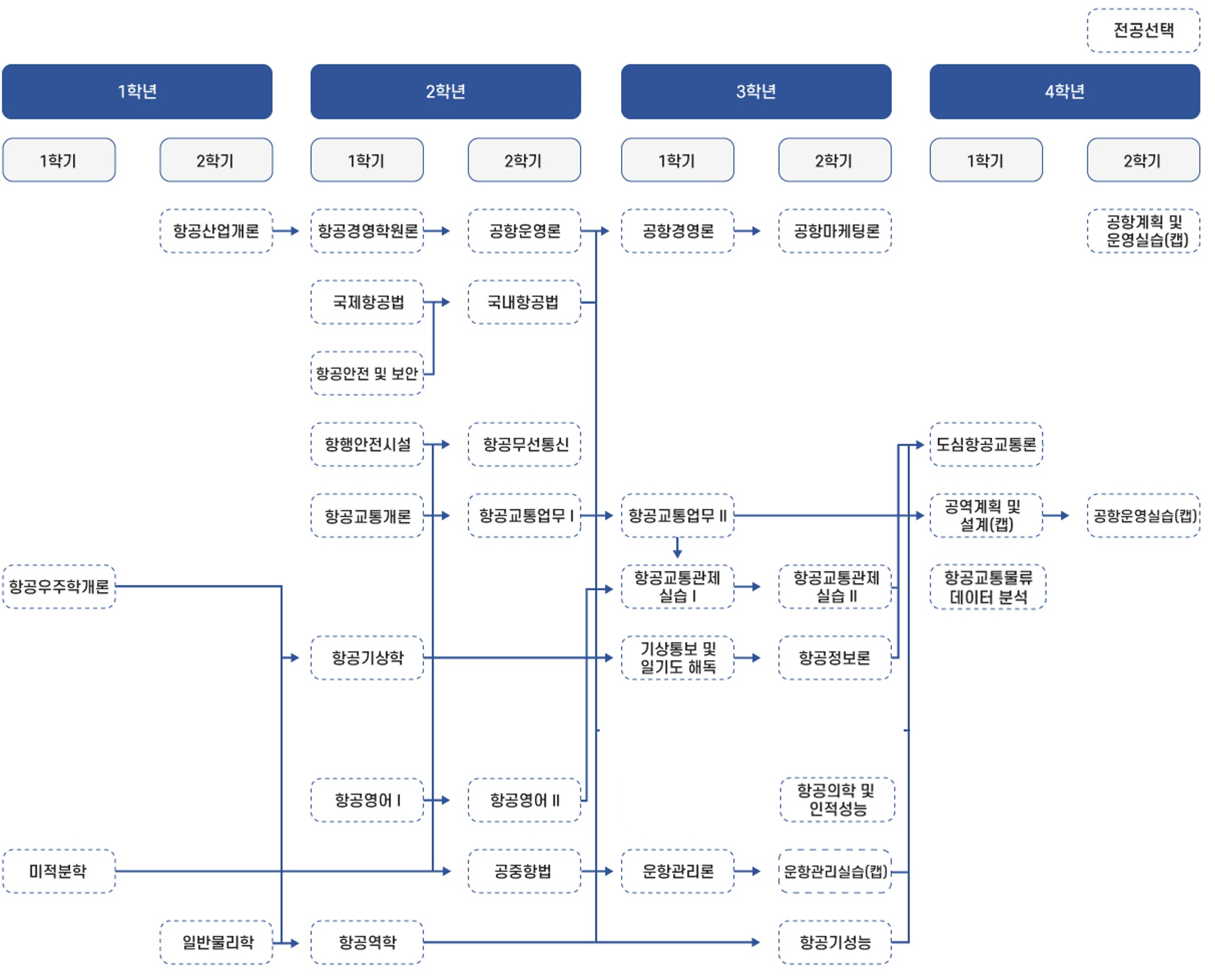
이수체계
전공교육과정 교과목 해설
- 물류학의 이해(Principles of Logistics) 3/3
- 물류부문에 있어서는 물류에 대한 기업별 국가별 장벽이 차차 약화되면서 물류에 대한 개념이나 인식이 운송이나 보관과 같은 종래의 부분적, 한정적 개념이나 활동으로부터 물류관련 활동은 총체적인 것으로 변화하고 있다. Logistics의 더욱 확대된 물류관리의 중요성이 요구되고 있고 이러한 전반적인 부분을 학습함. In the field of logistics, as the corporate or national obstacles are gradually weakening, the concept or perception of logistics has transformed from the partial or limited concepts like transport or storage of the past to more comprehensive logistics activities. Overall discussion of the expanded importance of logistics management required today.
- 항공교통개론(The Fundamentals of air traffic management) 3/3
- 항공교통관리의 개요를 설명하고 항공교통의 특성 및 구성요소를 살펴보며, 항공교통관리를 구성하는 공역관리, 항공교통업무, 항공교통흐름관리의 개념을 이해하도록 한다. An overview of air traffic management is explained, the characteristics and components of air traffic are examined, and the concepts of airspace management, air traffic services, and air traffic flow management that compose air traffic management are understood.
- 미적분학(Calculus) 3/3
- 항공 운항·관리·운영에 필요한 수학적 기초지식을 공부하는 교과목으로서, 미적분학 등을 다룬다. (As a subject to study the basic mathematical knowledge(e.g calculus) necessary for flight operation, management, and flight dispatch.)
- 항공안전 및 보안(Aviation Safety and Security) 2/3
- 항공안전 및 보안은 국제민간항공기구의 부속서 19인 SMS(SAFETY MANAGEMENT SYSTEM)의 주요 내용을 중심으로 학습하며 항공안전관리가 항공사, 공항, 관제기관에 필수적으로 접목하여 운영할 수 있도록 진행하고 있어서 항공안전관리에 대한 전반적인 내용을 강의하고 동시에 항공보안과 관련된 최신이론과 항공보안관련 법규, ICAO 규정에 대해 학습하고 공항보안, 항공사 보안, 항공보안시스템 및 항공보안정책 등에 대해 심도 있게 학습한다. 향후 항공안전분야와 항공보안관련 분야 종사를 목표로 하는 학생들에게 효과적인 학습이 될 수 있도록 강의한다. This course focuses on the main contents of SMS (SAFETY MANAGEMENT SYSTEM), Annex 19 of the International Civil Aviation Organization, so that aviation safety management can be essentially integrated and operated by airlines, airports, and air traffic control agencies. At the same time, students learn the latest theories related to aviation security, laws and regulations related to aviation security, ICAO regulations, and learn in-depth about airport security, airline security, aviation security systems, and aviation security policies. This course is designed to be an effective learning experience for students who aim to work in the aviation safety field and aviation security-related fields in the future.
- 항공우주학개론(Principles of Aeronautical Science) 3/3
- 유무인 고정익 및 회전익 항공기, 발사체, 위성 등과 같이 대기권 및 우주 공간을 비행하는 체계에 대해 학습하고, 대기권, 비행원리, 비행성능, 안정성, 항공기 구조와 감항성, 추진기관, 항공전자시스템 등 항공과 관련한 전반적인 분야에 대한 개론을 학습한다. Learn about systems that fly in the atmosphere and outer space, such as manned and unmanned fixed-wing and rotary-wing aircraft, rockets, and satellites. In addition, you will learn an introduction to all areas related to aviation, including the atmosphere, flight principles, flight performance, stability, aircraft structure and airworthiness, propulsion engines, and avionics systems.
- 일반물리학(General Physics) 3/3
- 실생활에서 볼 수 있는 물리적 현상에 대한 기본 개념을 고전역학, 열역학, 그리고 파동 등의 물리 법칙을 학습하여 이해하고, 논리적 설명 방법을 부여한다. 이 교과목의 주요 목표는 자연법칙에 대한 학생들의 이해를 증진하고, 비판적 사고력과 문제해결 능력을 강화하는데 있다. The aim of this course is to provide students with a principles and basic concepts of physics, and a logical explanation. This course covers classical mechanics, thermodynamics, and waves. The main goals of the course are to increase students understanding of natural laws and enhance students problem solving and critical thinking skills.
- 항공산업개론(Principles of Air Transport Industry) 3/3
- 항공과 운송분야를 접목하여 항공운송의 최신경향을 수업한다. 항공운송산업에서 항공사와 공항운영의 변화는 항공운송의 흐름과 함께한다. 대한항공과 같은 대형항공사, 제주항공과 같은 저비용항공사, 인천공항과 지역공항을 비롯하여 세계항공사와 공항의 변화를 수업을 통해 공유하는 것이 교과목이 갖고 있는 중요성이다. 따라서 학생들에게 항공산업분야중 항공운송 분야에 대해 체계적인 학습을 제공한다. This course combines the fields of aviation and transportation to teach the latest trends in air transportation. In the air transportation industry, changes in airline and airport operations go hand in hand with the flow of air transportation. The importance of the course is to share the changes in the world's airlines and airports, including large airlines such as Korean Airline, low-cost airlines such as Jeju Air, Incheon International Airport and regional airports, through the class. Therefore, it provides students with systematic learning about the air transportation field among the aviation industry fields.
- 항공경영학원론(Principles of Aviation management) 3/3
- 항공운송산업에서 중요한 부분을 차지하는 항공경영에 대한 전반적인 이론과 사례를 중심으로 강의가 진행된다. 국제공항전문가의 자격을 갖추기 위해서는 항공경영에 대한 기초개념, 기본이론, 항공물류서비스기업의 경영, 서비스 제공시설관리 및 운영 등을 폭넓게 다룬다. Lectures will be conducted focusing on the overall theory and examples of aviation management, which is an important part of the air transport industry. In order to qualify as an international airport expert, the basic concepts of aviation management, basic theory, management of aviation logistics service companies, and management and operation of service provision facilities are extensively covered
- 국제항공법(International Aviation Law & Regulations) 2/2
- 국제항공법은 국제민간항공협약과 국제항공협약 부속서를 기준으로 학습이 진행되며 이는 각국의 국내항공법을 제정하는 근거를 학생들에게 이해시키는 것이다. 국제민간항공의 발전에 대처하기 위한 국제항공법 이론과 실무능력의 함양을 위한 교육과 항공종사자로서의 필수적인 국제항공법 실무능력과 항공기업관계의 제법규를 다룬다. International aviation law is taught using the International Civil Aviation Convention and its annexes to provide students with an understanding of the rationale behind each country's national aviation laws. Discussion of international aviation law theory needed to respond to the development of international civil aviation, training for the advancement of practical capabilities in international aviation law required for aviation workers, and regulations on aviation companies.
- 항공영어 I, II(Aviation English I, II) 3/3
- 항공교통업무분야에서 사용되는 관제사와 조종사 간의 항공영어를 학습 및 실습하고, 항공교통 전공의 영문서 학습을 통해 전공영어의 활용 및 이해 능력을 향상 시키고자 한다. To improve the ability to utilize and understand major English through the lecture and practice of aviation English, between air traffic controller and pilot, used in the fields of air traffic services, and studying English documents related to air traffic subjects.
- 항행안전시설(Air Navigation Aids) 3/3
- 항공기가 출발공항에서부터 목적지공항까지 안전하고 효율적으로 운항할 수 있도록 지원하는 시설인 항공등화, 항행안전무선시설 및 항공정보통신시설의 기능과 역할에 대하여 학습한다. Explore the pivotal functions and roles of lighting, radio navigation aids, and aviation information and communication facilities. These integral components ensure the safe and efficient operation of aircraft from departure to arrival, guiding them seamlessly from their point of origin to their final destination.
- 항공기상학(Aviation Weather) 3/3
- 항공기가 운항하는 대기의 기상 현상에 대한 원리를 이해하여 항공기 운항에 어떠한 영향을 미치는지에 대하여 학습한다. Grasp the fundamental principles of meteorological phenomena that occur in the atmospheric environment where aircraft operate, and comprehend their impact on aircraft operations.
- 항공역학(Aerodynamics) 3/3
- 항공기가 비행하는 대기의 구성 및 공기의 특성을 이해하고, 비행 중인 항공기에 작용하는 물리적인 힘과 작용하는 힘이 항공기 성능과 특성에 어떠한 영향을 주는지를 학습한다. 특히, 항공기 양력, 항력, 정적 성능, 이착륙 및 항속 성능, 비행한계, 항공기 무게 및 중심, 항공기 안정성 및 조종성에 대한 이론을 학습한다. Understand the composition and characteristics of the atmosphere in which aircraft fly, and learn about the physical forces acting on aircraft in flight and how these forces affect aircraft performance and characteristics. In particular, we learn theories about aircraft lift, drag, static performance, takeoff and landing and cruising performance, flight limits, aircraft weight and center of gravity, and aircraft stability and controllability.
- 공항운영론(Airport Operation) 3/3
- 항공운송시스템의 주요부문 중의 하나인 항공·공항분야의 운영 및 관리에 대한 교육과 관련하여 항공·공항운영에 대한 이론과 사례분석을 통해 공항운영의 폭넓은 지식을 전수할 수 있도록 한다. 세계 각국은 과거 공항을 공공적인 측면에서 바라보는 시각에서 공항민영화를 통한 공항의 운영체제에 대한 변화를 모색하고 있고 공항을 효율적으로 운영하여 안전한 교통수단의 제공 및 수익적인 측면을 고려하고 있다. 항공교통을 전공하고 공항에 종사하고자 하는 학생들은 공항의 전반적인 운영내용을 이해하고 있어야 하기에 공항 선진화에 대한 변화 내용을 학습하고 공항시스템에서 공항에 필요한 운영의 전반적인 이론을 강의한다. With regard to the education on the operation and management of airports, which is one of the major sectors of the air transportation system, this course provides a wide range of knowledge on airport operations through theoretical and case analysis of airport operations. Countries around the world are looking for changes in the operating system of airports through airport privatization from the perspective of viewing airports from a public perspective in the past, and are considering profitable aspects as well as providing safe transportation by operating airports efficiently. Students who major in air transportation and want to work in airports must understand the overall operation of airports, so they learn the changes in the development of airports and teach the overall theory of operations required for airports in the airport system.
- 항공교통업무 I, II(Air Traffic Service I, II) 3/3
- ICAO ANNEX 11. Air Traffic Services를 바탕으로 항공교통 관제업무에 필요한 용어를 학습하고, 항공교통 관제업무를 위한 공역 등급, 항공기 분리 등을 학습한다. 또한, 비행정보업무(ATIS 등)과 경보업무(수색 및 구조 등)에 대한 지식도 함께 학습한다. 아울러, 국토교통부 고시-항공교통 관제절차를 바탕으로 항공기 안전운항을 확보하고 공중충돌 등을 방지하기 위해 국내에서 적용되고 있는 세부기준을 학습한다. Based on ICAO ANNEX 11. Air Traffic Services, learn terminology necessary for air traffic control, and learn airspace classes, aircraft separation, etc. for air traffic control. In addition, knowledge about flight information services (ATIS, etc.) and warning services (search and rescue, etc.) are also learned. In addition, based on the Ministry of Land, Infrastructure and Transport's notice - air traffic control procedures, learn detailed standards applied domestically to ensure safe aircraft operation and prevent mid-air collisions.
- 국내항공법(Domestic Aviation Law & Regulations) 3/3
- 국내항공법은 항공안전법, 공항시설법, 항공사업법으로 분법이 되었는데 항공종사자에게 필요한 항공안전법을 중심으로 학습이 진행된다. 국제항공법을 선행 학습한 기반으로 우리나라 항공법령의 기초지식을 습득하게 하고 항공종사자로서의 필수적인 항공법 실무능력과 항공기업관계 제 법규를 강의한다. Domestic aviation law has been divided into aviation safety law, airport facilities law, and aviation business law, and the course will focus on aviation safety law required for aviation workers. Students will acquire basic knowledge of Korean aviation law based on previous study of international aviation law, and will be taught practical aviation law skills and regulations governing aviation business relations, which are essential for aviation professionals.
- 공중항법(Principles of Navigation) 3/3
- 특정 위치 또는 지점에서 자신의 위치를 결정하여 효율적으로 목적지까지 안전하게 운항하기 위한 항행기술에 대하여 학습한다. Learn about the principles of navigation, a skill that allows you to checkpoint your exact location and chart an efficient and safe course to desired destination.
- 기상통보 및 일기도 해설(Aiviation Weather Service) 3/3
- 비행계획 작성을 위한 기상 정시보고와 예보를 해석하고 일기도 분석을 통해 항공기운항에 필요한 기상정보를 습득하도록 한다. Understand about weather reports(METAR) and Terminal Aerodrome Forecast to make flight plans, and garner essential meteorological information for aircraft operations through the analysis of weather charts.
- 공항경영론(Airport Management) 2/3
- 공항의 경영관리 체계, 공항터미널운용, 공항시설의 관리 및 공항계획에 관한 이론을 강의한다. 공항경영과 관련한 세부 분야를 공항의 이윤 극대화 측면에서 취급, 공항의 인사조직및 관리, 비용관리, 수입관리, 에어사이드의 공항이용료, 컨세션관리, 공항마케팅 등을 포함하는 공항운영의 사기업적 측면을 다룬다. Education on the management system of airports, operation of airport terminals, management of airport facilities, and airport planning. Discussion of the private enterprise aspect of Airport Operations, treating specific fields of Airport Operations from the perspective of maximized profit, including airport personnel organization and management, cost management, income management, airside airport usage fees, concession management, and airport marketing.
- 항공교통관제실습 I, II(Air Traffic Control Service Lab I, II) 2/4
- 항공교통관제의 특성과 절차를 실습한다. Practice of the characteristics and procedures of air traffic control.
- 항공운항실습I,II,Ⅲ(Flight operation training I,II,Ⅲ) 1/2
- 항공기 조종 훈련을 통하여 항공기 운영에 대한 전반적인 이해를 돕기 위한 실습을 한다. Flight Training(PPL) to aid the overall understanding of aircraft operation.
- 항공의학 및 인적성능(Aviation Medicine and Human Factors) 3/3
- 항공 운항(조종, 관제, 운항관리 등 항공종사자)과 관련한 항공의학과 인적요인의 개념을 학습한다. 특히, 항공생리와 항공심리, 직무와 신체조건의 적정성 등에 대한 이론을 학습하고, 인적요인의 중요성과 SHELL, PEAR 등의 분석방법을 학습한다. 아울러 승무원 자원관리(CRM)에 대한 배경과 과정을 학습한다. Learn the concepts of aviation medicine and human factors related to aviation operations (flight operation, air traffic control, flight management, etc.). Specifically, you will learn theories about aviation physiology, aviation psychology, and the appropriateness of job and physical conditions, as well as the importance of human factors and analysis methods such as SHELL and PEAR. In addition, learn the background and process of crew resource management (CRM).
- 운항관리론(Flight Dispatch) 3/3
- 비행계획 수립을 위한 운항 정보, 기상, 항공기 성능을 확인하고, 비행 감시 등 계획 대비 실제 운항 상황 파악 등 운항관리사 업무에 대한 전반적인 지식을 학습한다. Acquire a broad understanding of the role of a flight dispatcher, which includes tasks such as checking flight information, assessing weather conditions, and evaluating aircraft performance for flight planning. Additionally, flight dispatchers are responsible for monitoring actual flight conditions and comparing them against planned parameters, such as through flight surveillance.
- 항공정보론(Aeronautical Information Service) 3/3
- 안전하고 규칙적이며 경제적인 국제 항공교통관리 체계를 유지하기 위한 지속적인 항공데이터 및 항공정보의 흐름을 확보하는데 필수적인 AIP, NOTAM, AIC 등 항공정보업무에 사용되는 형식과 정보를 학습한다. Learn the formats and information used in aeronautical information services such as AIP, NOTAM, and AIC, which are essential for securing the continuous flow of aviation data and aviation information to maintain a safe, regular, and economical international air traffic management system.
- 공항마케팅론(Airport Marketing) 3/3
- 학생들에게 공항운영 분야에 대한 지식을 습득하게 하고 발표준비를 통해 새로운 마케팅분야를 경험하게 한다. 학생의견을 수렴하여 발표를 통해 토론방식으로 수업이 진행되기에 의견이 자연스럽게 도출되며 수업에 대한 피드백을 수업평가를 통해 진행한다. 융복합교과목 관련 사례로 공항운영론과 마케팅론의 접목으로 융합적인 과목으로 진행하며 학생들에게 공항운영 분야중 공항마케팅 분야에 대해 체계적인 학습을 제공한다. Students acquire knowledge in the field of airport operation and experience new marketing fields through presentation preparation. Since the class is conducted in a discussion method through presentations by collecting student opinions, opinions are naturally derived, and feedback on the class is conducted through class evaluation. As an example of a convergence course, it is conducted as a convergence course by combining airport operation theory and marketing theory, and provides students with systematic learning about the airport marketing field among the airport operation fields.
- 항공기성능(Aircraft Performance) 3/3
- 항공기 성능은 운항단계별 (이륙, 상승, 순항, 강하. 착륙)로 중량, 속도, 연료소모량, 추력, 이륙거리, 착륙거리 등을 산출하는 과목으로 비행계획의 근간을 이룬다. 이를 이해함으로써 항공기 운항의 기술지원 능력을 함양할 수 있다. Aircraft performance is a course calculating weight, velocity, fuel consumption, thrust, take-off distance, and landing distance for each phase of flight operation (take-off, ascent, cruise, descent, landing), forming the basis of flight planning. Understanding of aircraft performance can advance technical support capability for flight operation.
- 운항관리실습(Flight Dispatch Lab) -캡스톤 디자인 2/3
- 효율적인 운항을 위한 비행계획, 운항 정보 파악, 기상 확인, 계획 대비 실제 운항 상황 모니터링 등 운항관리사 업무에 필요한 실무능력을 과제 수행을 통해 학습한다. Acquire the practical skills necessary for the role of a flight dispatcher. This includes devising efficient flight plans, identifying crucial flight information, assessing weather conditions, and comparing actual flight conditions against planned parameters, all through hands-on task execution.
- 항공무선통신(Aeronautical Telecommunication) 3/3
- 항공정보통신시설, 감시시스템(레이더, 비행정보서비스, 항행시스템 등), 무선통신 장비원리(운용 및 절차) 등 항공통신에 관한 일반지식을 학습한다. 특히, 비행장 관제, 접근관제, 항로관제 운영절차에 필요한 레이더 용어와 조난, 비상, 긴급통신방법과 절차에 대해 학습한다. Learn general knowledge about aviation communication, including aviation information and communication facilities, surveillance systems (radar, flight information service, navigation system, etc.), and wireless communication equipment principles (operation and procedures). In particular, learn radar terminology necessary for airfield control, approach control, and area control operation procedures, and learn about distress and emergency communication methods and procedures.
- 공역계획 및 설계-캡스톤 디자인(Airspace Planning & Design Practice-Capstone Design) 2/3
- 계기비행절차설계에 관한 국제기준과 설계 프로그램을 단계별로 학습하고 이를 태안비행장에 적용하여 접근절차를 수립해 본다. Learn international standards for instrument flight procedure design and design program(AutoCAD) step by step, and establish approach procedures of Taean airfield based on the study.
- 도심항공교통론(Principles of Urban Air Mobility)
- 도심항공교통(UAM)의 등장배경, 현황 및 전망 등 개요와 국내외 동향과 정책에 대해 학습한다. 또한, UAM의 특성 및 구성요소에 따라 UAM 교통관리, 운항관리, 버티포트 운영, 안전 및 보안 등 UAM 운영에 필요한 전반적인 내용에 대한 개념을 학습한다. Learn about the background, current status, and prospects of Urban Air Mobility(UAM), as well as domestic and international trends and policies. In addition, depending on the characteristics and components of UAM, you will learn the concepts of overall contents necessary for UAM operation, such as UAM traffic management, flight management, vertiport operation, safety and security.
- 항공교통물류데이터분석(Air Transportation & Logistics Data Analysis)
- 항공교통 및 물류 관련 데이터를 분석하기 위한 기초통계, 최적화, 시뮬레이션 분석 등 데이터 활용능력을 학습한다. 엑셀 등 데이터 분석에 필요한 도구를 기본적으로 다루며, 항공기 운항 스케줄, 항공교통/물류 종사자 근무 스케줄, 항공기 항적, 안전 데이터 등을 함수, 그래프 등을 활용하여 분석하는 내용을 다룬다. Learn data utilization skills such as basic statistics, optimization, and simulation analysis to analyze data related to air traffic and logistics. It covers the basic tools needed for data analysis, such as Excel, and covers analysis of aircraft flight schedules, work schedules for air transportation/logistics workers, aircraft tracks, and safety data using functions, graphs, etc.
- 공항계획 및 운영실습-캡스톤디자인(Planning & Operation of Airport-Capston Design) 2/3
- 인천국제공항공사의 ICAO 비행장검사자 과정과 연계하여 공항시설과 관련된 공항계획 및 운영에 관하여 학습하고 이를 태안비행장에 적용하여 비행장검사 및 비행장 운영프로젝트를 수행한다. Learn airport planning and operation related to airport facilities in connection with IIAC's ICAO aerodrome inspector course, and perform aerodrome inspection and aerodrome operation projects for Taean airfield based on the study.
- 공항운영실습(Airport Operation Lab) 2/3
- 팀별로 공항운영 이슈에 대한 내용을 프로젝트 위주로 발표준비를 한다. 팀별 프로젝트와 개별 프로젝트 발표로 수업이 진행된다. 매주 발표된 내용을 중심으로 수정 보완하고 피드백을 통해 팀별 프로젝트의 완성도를 높이는 학습을 진행한다. 이를 통해 각 팀별주제와 개인의 관심주제를 연결하여 발표를 하게 되는데 이는 한국공항공사에서 공항운영에 필요한 업무를 수월하게 할 수 있도록 준비를 하는 것이다. 공항운영실습은 공항운영전문가 과정으로 항공교통물류학부 학생을 대상으로 공항운영분야 전문가 배출을 목표로 한다. 한국공항공사나 인천공항공사에 진출하고자 하는 학생 중심으로 공항운영 분야의 전반적인 이론을 학습한다. Each team will prepare a project-based presentation on an airport operation issue. The class will be organized into team projects and individual project presentations. Each week, the students will learn to improve the quality of each team's project by revising and supplementing the contents of the presentation and providing feedback. Through this, each team will make a presentation by connecting the topic of each team and the topic of individual interest, which will prepare them to easily perform the tasks required for airport operation at Korea Airports Corporation. The Airport Operation Practicum is an airport operation specialist course that aims to produce experts in the field of airport operation for students in the Department of Aviation, Transportation, and Logistics. Students who want to work for Korea Airlines or Incheon Airport will learn the overall theory of airport operations.